Tuesday, December 31, 2013

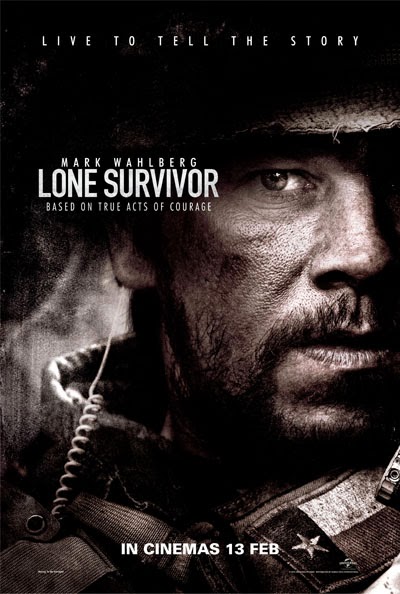
Lone Survivor

It is pretty obvious that movies have desensitized us to violence in a lot of ways. Action movies are filled with explosions and guns that average 1,000 shots before they actually hit a target. But Lone Survivor proves that the ferocity of warfare still has an impact. The film tells the brutal true story of four Navy SEALS attempting to survive a fire fight with the Taliban after they are discovered by a group of goat herders in Afghanistan. As the film’s title suggests, the viewer knows the mission isn’t a success and that most of the characters don’t make it out. But that does little to soften the blow.

Director Peter Berg has a strict eye for realism in the film. The real life survivor of the events shown in the film, Marcus Lutrell, played a big part consulting on the project. He also wrote the book that was the inspiration for the film. Mark Wahlberg plays Lutrell, who gives a strong performance. He is even able to infuse some comedy into the tough as nails plot in a way that only Wahlberg could. Taylor Kitsch, Emile Hirsch and Ben Foster play the other leads in equally as impressive fashion.

Wahlberg is featured prominently in the advertising as the most famous of the bunch and title character, but for the first two-thirds of the film, the cast are equal in their screen time. It seems petty to talk about the script and pacing when the message of the film is so intense, and ultimately heartbreaking, but both are strong. It’s easy to forget that countless servicemen and women have risked so much like the individuals in Lone Survivor did. And that’s why the film is so important. It should be remembered as one of the best military films of all time. Its story comes first. The film is shot beautifully, but that won’t be remembered in the face of the true story.

Each film earns either zero, a half or a full arrow in five categories. The categories are Acting, Writing/Directing, Emotion, Innovation and Overall Impression. The arrows are added up to equal the full score.

Monday, December 30, 2013

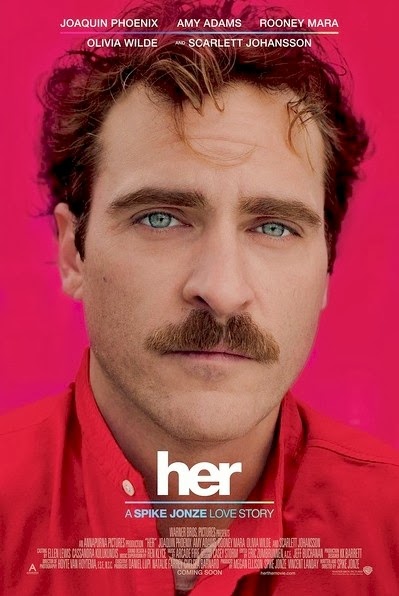
Her

Well people asked for a sci-fi movie to be respected in the Oscars discussion and now they have one. But with no lightsabers or Avengers in sight, I don’t think Her is really what people meant. The movie follows Joaquin Phoenix, who plays a lonely, newly separated man as he buys a new computer operating system. As the “OS,” voiced by Scarlett Johansson, and Phoneix’s character get to know each other, they develop a relationship. Written and directed by Spike Jonze, Her is an odd film, but odd in a way that is totally believable.

Throughout the majority of the movie, Phoenix is the only actor on screen. But with a strong performance, it’s very easy to forget that. Johansson also deserves significant credit for her performance as Samantha, the OS. We can talk about the commentary on modern love that the film represents, but it needs to be said that there are moments where the film is just plain weird. Iconic images like Phoenix dancing in the cabin actually come off better out of context than in the movie. It’s not really the fact that the character is dating a computer; it’s the world Jonze has created.

But as many of the award shows have agreed, the screenplay is well written. Jonze establishes the characters and their relationship in a short amount of time as we see a couple take a natural course in a standard length motion picture. Her is paced well and will be remembered for Phoenix and Johansson’s chemistry. So this isn’t the type of sci-fi movie you were looking for at the Oscars. But it’s likely the only type of sci-fi story the stodgy Oscar voters would get behind.

Each film earns either zero, a half or a full arrow in five categories. The categories are Acting, Writing/Directing, Emotion, Innovation and Overall Impression. The arrows are added up to equal the full score.
Thursday, December 26, 2013

The Secret Life of Walter Mitty

I often like to do a bit of research before I go and see a new movie. In the case of The Secret Life of Walter Mitty I watched the 1947 version of the film. Well it is quite different from the 2013 release and both vary a lot from the 1939 short story. All three incarnations are centered on a mild-mannered guy who escapes reality with elaborate daydreams. The new release has Ben Stiller, who also directed the film, starring as Mitty. When he misplaces an important photo, he turns his daydreams into reality as he crosses the globe looking for the photographer, played by Sean Penn. Kristen Wiig also stars as Mitty’s love interest.

Stiller, the occasional director, presents one of the most visually impressive films of the year capturing the vast locales presented on the character’s journey. In addition, the daydreams are complimented well with visual effects that bring to mind epic sci-fi projects. Stiller’s directorial style in the film fits the character he plays as each scene takes its time to establish relevance. In the vast majority of cases, those scenes deliver. In terms of his acting, Stiller gives a rewarding performance that has subtle humor alluding to his over the top legacy as a comedic a-lister while staying true to the quiet Mitty.

As a story that has a tumultuous history filled with failed attempts of getting made, Stiller makes the concept look easy. The daydreams carry the story in the first half, but the focus is always on Mitty and that internal struggle of comfort versus adventure. It’s such a relatable premise that the audience establishes a quick likening with the character. Even though the marketing pushes the daydreaming elements heavily, the story is more about realizing those dreams in actuality. That is a theme shared with the 1947 effort. So at the end of the day, the two movies aren’t that different after all.

Each film earns either zero, a half or a full arrow in five categories. The categories are Acting, Writing/Directing, Emotion, Innovation and Overall Impression. The arrows are added up to equal the full score.

Wednesday, December 25, 2013

47 Ronin

When you hear about the budgetary and production problems like the ones 47 Ronin has had, it’s tough for it to turn a profit and be considered successful. But being promoted to look like a samurai version of 300 is a good way to appeal to the masses. Keanu Reeves stars in the film about a group of Ronin, samurai without a master, attempting to avenge the death of their master. The premise is based on the true story that is well known in Japanese culture. But the shape-shifting witch lady from the film who can turn into a dragon seems to be missing from the historical accounts.

Keanu Reeves actually fits well into the movie as a former slave. He gives a mysterious performance with convincing sword skills. His dialogue isn’t the best, but when his mouth is closed, Kenau carries the film well. Japanese actor Hiroyuki Sanada, who plays samurai as often as Robert De Niro plays mobsters, gives depth to the plot in a way Reeves isn’t asked to do. As a respected samurai, the character’s plight throughout the movie is used to represent the emotions of the whole group.

Even with all the sci-fi elements, there are a number of dull moments in the middle of the film. The action and fight choreography delivers though as the epic samurai sword fights frame the conflict well. The movie is a decent action film that would have benefitted from a different release date. The large number of films that shared the Christmas opening cancelled each other out in many cases. Plus there are far too many heads being cut off by swords for families to enjoy this on Christmas Day. But Keanu and company have success in the film that capitalizes on the intriguing elements of samurai culture.

Each film earns either zero, a half or a full arrow in five categories. The categories are Acting, Writing/Directing, Emotion, Innovation and Overall Impression. The arrows are added up to equal the full score.

Tuesday, December 24, 2013

American Hustle

In 2010, The Fighter starred Christian Bale and Amy Adams. 2012’s Silver Linings Playbook had Bradley Cooper and Jennifer Lawrence. Now, the culmination of director David O. Russell’s cast cycle, American Hustle stars all four of them together. The film, loosely based on a true story, has Bale playing a con-man. But when he and his partner (Adams) get caught by a FBI agent, (Cooper) they are forced to help in an operation. Lawrence plays Bale’s character’s caddy wife. Jeremy Renner also stars as the mayor of Camden, New Jersey, who plays a prominent part in the sting.

Bale’s intense immersion into his roles has been well documented, so the gained weight and comb over are accepted almost instantly as another layer of the Oscar winner’s legacy. Harder to accept is America’s sweetheart, Jennifer Lawrence’s turn as the annoying, meddling housewife. She does well with the role as it doesn’t take the audience long to turn on the character, which is the desired effect. Similarly, it’s not often we see Cooper as the shady confusing guy he plays here, but I would argue this performance is even better than the Oscar nominated one from Silver Linings. It’s more layered and complicated.

The story has the effect that it’s tough to know if you should be laughing or not. The plot development is perfectly paced and without any hiccups as the large number of central figures are each developed. But like the main character, the movie is complicated and not overly concerned with genre. American Hustle is a strong movie through and through. It’s witty and filled with twists, but not in the way an average moviegoer would appreciate. The characters are the focus, and with a cast list that looks like an Oscar ballot, it’s easy to see why the film is so successful.

Each film earns either zero, a half or a full arrow in five categories. The categories are Acting, Writing/Directing, Emotion, Innovation and Overall Impression. The arrows are added up to equal the full score.

Monday, December 23, 2013

The Wolf of Wall Street

Everyone is talking about how much swearing there is in The Wolf of Wall Street. Well beyond that there is a lot of nudity, drug use and illegal activity. But this is a Martin Scorsese movie. There is always something to annoy the censors. The film, like most of those in the Oscar conversation, is based on a true story. Leonardo DiCaprio plays Jordan Belfort, a powerful stockbroker, who navigates Wall Street with sex, drugs and corruption. Eventually it all catches up to him.

DiCaprio gives a strong performance that is on par with the year’s best. The character is so intense and full of negative traits, it’s a testament to DiCaprio that the audience still cares about him. Jonah Hill, who co-stars as DiCaprio’s right-hand man, shows his acting prowess as he builds his résumé outside of more standard comedy. But it must be said that the drug-fueled fight scene between DiCaprio and Hill is the most ridiculous (in a good way) scene either have been a part of. And remember, this is the guy from Superbad and 21 Jump Street we’re talking about. Margot Robbie, who plays DiCaprio’s wife, is the other standout in the film.

The movie is certainly a long one, running just under three hours. But that doesn’t mean it is slow moving. In fact, The Wolf of Wall Street has a pretty quick pace, even if there are a number of scenes that could be cut without sacrificing any plot development. At this point, it’s hard to pinpoint what works Martin Scorsese will be best remembered for. It probably won’t be this, but it is a well done film and one of the best collaborations between Scorsese and DiCaprio. Following up the child filled ode to film, Hugo with the drug-filled orgy that is The Wolf of Wall Street may seem like a strange choice. But one look through Scorsese’s filmography and it’s one that makes perfect sense.

Each film earns either zero, a half or a full arrow in five categories. The categories are Acting, Writing/Directing, Emotion, Innovation and Overall Impression. The arrows are added up to equal the full score.